
One of the biggest claims against the church of today is that it is full of hypocrites. Unfortunately, that is many times true. I have heard it said many times that “Of course the Church is full of hypocrites!” “We are imperfect people and we have sin, we recognize it, and that is why we are at church in the first place!”
I have oftentimes agreed with this sentiment. I know that I am not perfect and I know that I have sin. I don’t want to see the sins of others and not recognize the log in my own eye. I fail. I am not who I wish I was in Christ yet. But I think that we should possibly be careful not to write the judgment of the world that we are hypocrites off as if it isn’t an area where we need to focus.
I think if Jesus was here today, He would take very seriously the accusation that we are hypocrites here in the church today. I think there is a lot that we can learn about the hypocrisy of the Scribes and Pharisees in order to avoid these same kinds of hypocrisy in our own lives. So with that in mind, can we all turn to Matthew Chapter 23, but first, let’s open with prayer.
They Did Not Do What They Told Others to Do
First, let us set the scene. In Matthew 23 Jesus is speaking to the crowds and to his disciples. At some point, it seems that Jesus transitions from speaking to the people at large and addresses the scribes and Pharisees directly with his “woes”. I am not sure whether there were scribes and Pharisees present in the crowd, or if after Jesus starts speaking about them someone goes and says “Hey guys, you gotta hear what this Jesus guy is saying about you!” I don’t know, but at any rate, Jesus goes on to condemn the way that the scribes and Pharisees are living to the crowd.
Jesus hated hypocrites, just like the unbeliever does. In Matthew chapter 23 Jesus gives seven woes to the Scribes & Pharisees that all relate to the hypocrisy that Jesus saw inside of Judaism. Jesus didn’t pull any punches when it came to the Pharisees and the Scribes of the Law. He was blunt. Very, blunt. And He did this publicly in front of a crowd! Maybe I am reading more into this than there is, but I think we can see the anguish that Jesus feels over the state of the people. These Scribes and Pharisees are supposed to be the teachers of the Jewish traditions. (Matt 23:1-3) These people were to “sit on Moses’ seat”. When it says that they sit in Moses’ seat it means that they had the leadership position that Moses held in relation to the people of Israel. Moses was a spiritual leader as well as a leader of the nation. While God was the ruler over this theocracy, Moses was the man that people came to in order to ask the what the will of God was. People would bring their problems to Moses. We read in Exodus 18 that Moses’ father-in-law, Jethro, comes to meet Moses and praises God for the deliverance of their Israelite people. (We can probably identify with Moses here having his father-in-law come to visit. There is a bit of trepidation there.) The second day that Moses’ father-in-law was there Moses had to go to work. Let’s see how Moses’ father-in-law reacts to what he sees.
Exodus 18:13-15 NIV > 13 The next day Moses took his seat to serve as judge for the people, and they stood around him from morning till evening. 14 When his father-in-law saw all that Moses was doing for the people, he said, “What is this you are doing for the people? Why do you alone sit as judge, while all these people stand around you from morning till evening?” > > 15 Moses answered him, “Because the people come to me to seek God’s will.
This is the place that the Scribes and Pharisees held in their society. They were there to seek the will of God for people’s lives in order to tell them how to live and fulfill the will of God in their lives. We see that Jesus does not dispute their position, in fact, He affirms it. In verse 3 of Matthew 23 Jesus says “do and observe whatever they tell you”. It was their right, it was their duty, it was their privilege and it was their responsibility to perform the duties of Moses for the people of Israel and they weren’t living it out.
So before we get to the point of looking at their hypocrisy, we should first acknowledge that they were within their right to be performing these duties. They weren’t usurping power here. This was their place.
Unfortunately, being in this place of authority had gone to their heads.
The Scribes and Pharisees were hypocrites first of all because they did not do what they told others to do.
Matthew 23:3-4 ESV > 3 so do and observe whatever they tell you, but not the works they do. For they preach, but do not practice. 4 They tie up heavy burdens, hard to bear, and lay them on people’s shoulders, but they themselves are not willing to move them with their finger.
This imagery is fantastic of tying up burdens on the shoulders, which means something is heavy. You can’t simply move it with your hands, you need to get your shoulders and your back into the load in order to move it.

Yet the Scribes and Pharisees they won’t lift even their finger to move these same loads they are binding on the people. The laziness, the arrogance, the self-importance that is given in this imagery is a real punch in the stomach.
When teaching reading to children, one of the main things that studies have shown, time and time again is that one of the main contributing factors to a child’s ability to read or pick up reading is that the parent reads at home with them. In essence, if reading is not that important or is not done for enjoyment at home by the parents, the children thing “Well if my Mum and Dad aren’t going to do it, I’m not going to either.”
It is the same with these scribes and Pharisees, why would the people want to do what they say if they aren’t willing to do it themselves.
We have to wonder then, why are the Scribes and Pharisees like this? Why do they act this way? How can we avoid acting this way ourselves? The reason that acted like this is because…
They Did Their Deeds to be Seen by Men
The Scribes and Pharisees “wore their phylacteries broad and their fringes long. I really wanted to come in today with some of these items, just to show what they looked like. The phylacteries or “Tefillin” are small leather boxes that are worn on the forehead and arm. They are filled with scrolls that contain four scriptures, Exodus 13:1-10, Exodus 13:11-16, Deut. 6:4-9 and Deut. 11:13-21. These four passages from the Torah, the first five books of the Bible, all include the commandment to bind these Tefillin as a sign or symbol of their faith and devotion. I thought it would be great fun to bring one of these in to show you, but I found out that a phylactery can cost anywhere from a measly $300 to a couple thousand dollars.

I also wanted to look into the “fringes”, which probably refers to the “tallit” or prayer shawl that had “tzitzit’s” or, “fringes” at the corners of the garment. These fringes had meaning.
Quote from chabad.org >The fringe tassels themselves are called tzitzit. Their strings and knots are a physical representation of the Torah’s 613 do’s and don’ts. It works like this: Each letter in the Hebrew alphabet has a corresponding numerical value. The numerical values of the five letters that comprise the Hebrew word tzitzit add up to 600. Add the eight strings and five knots of each tassel, and the total is 613.

All of these things were supposed to remind the Jewish person that God is to be on their mind, in their hearts and in their actions. The Scribes and Pharisees had turned this into a fashion statement or a proclamation of their own importance instead. (As an aside if you want to know why some are dyed blue, while others are not, you can find that information at chabad.org)
How does this relate to us though? We don’t wear “Teffilin” or or “tallit’s” or have “tzitzits”. Do you have a fish on your car? Do you wear Christian logo t-shirts? Do you prominently display scripture verses or your Bible in your home?
I’m sure we have all heard the story of a motorist who was driving down the highway in a bad mood. He’d had a terrible day at work and was in a sour mood and as he was driving down the highway he had someone behind him that kept honking their horn. So the man pulled into another lane so that the driver would go around, but the driver did not go around, he simply pulled in back behind him and kept honking. Finally, the man slammed on the brakes, nearly being rear ended by the person behind him, got out of his car and screamed and yelled and…spoke quite unkind things… at the person behind him for honking at him for the last five kilometers. After a five minute tirade, the frustrated, screaming man finally asked the driver why he was honking in the first place. To which the driver, who had been silent during this entire ordeal calmly said, I just saw your “honk if you love Jesus bumper sticker”.
We need to do our deeds to be seen by God and not men and not simply wear our faith like a cloak we put on and take off (or in this case, stick on and peel off). That isn’t to say that we can’t have our Christian logo t-shirts or any of those other things, but it is to say that those things are not our witness, we are! We are the witness and those things are just reminders for ourselves to keep us on track. We need to remember that as Romans 12 says, our “lives” are the living sacrifice. Not how many Jesus fish stickers we can put on our possessions. Or how many good deeds we can do where people can see how “good” we are.
The passage continues in Matthew 23:6-7 to outline the things that the scribes and Pharisees enjoy about the spotlight of their position and how they ought to have been humble instead of prideful, because…
They Put Themselves in the Place of God
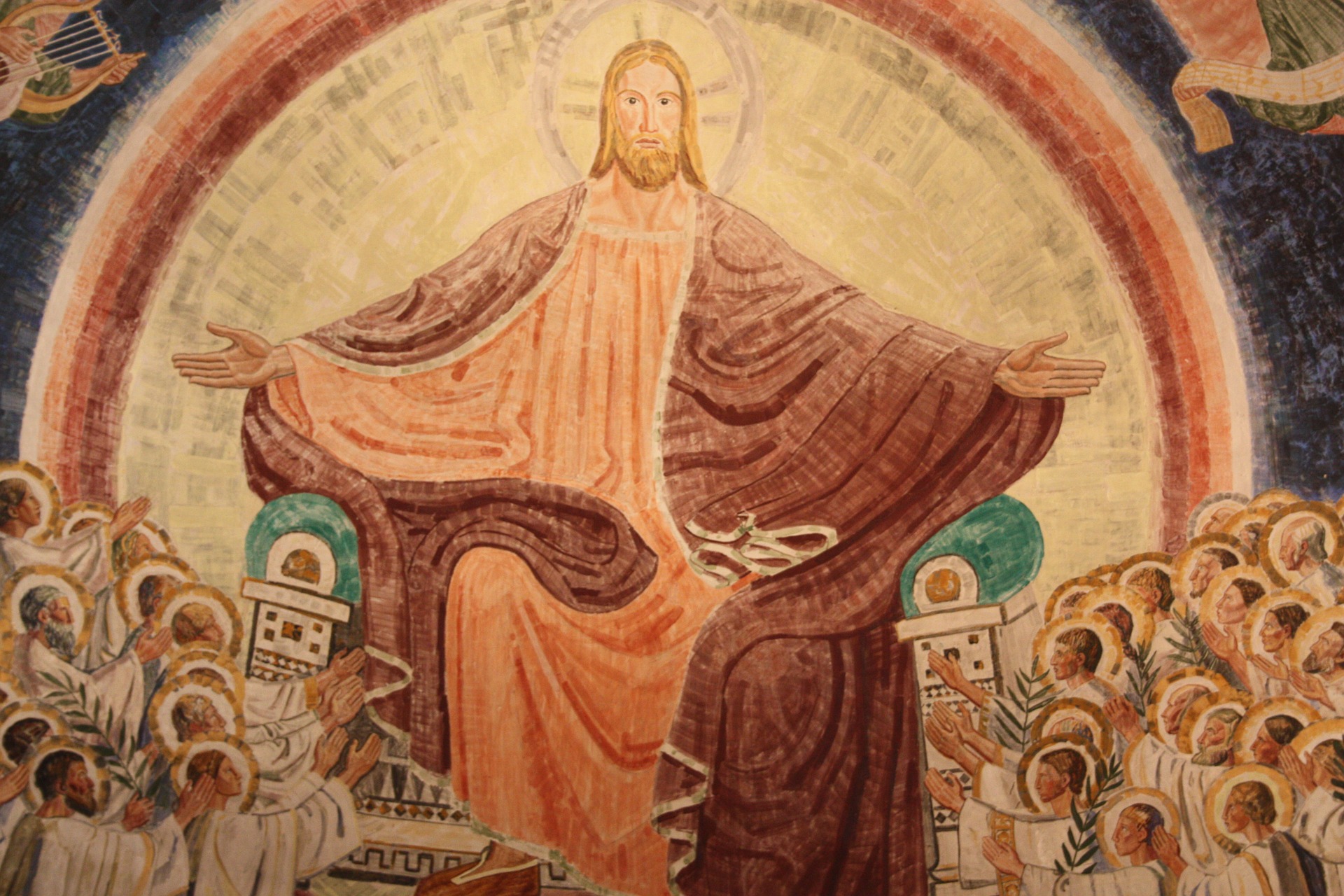
Jesus switches from telling the people what the scribes and Pharisees are like and begins to use the word “you”, addressing the scribes and Pharisees that must be in the midst of the crowd.
Matthew 23:8 ESV > 8 But you are not to be called rabbi, for you have one teacher, and you are all brothers. 9 And call no man your father on earth, for you have one Father, who is in heaven. 10 Neither be called instructors, for you have one instructor, the Christ. 11 The greatest among you shall be your servant. 12 Whoever exalts himself will be humbled, and whoever humbles himself will be exalted.
The scribes and Pharisees are hypocrites because they have put themselves in this highly exalted position have usurped a position that should only have been held by God. These people are men, just like us, and yet they were lording their power and their prestige over the very people that they are supposed to be serving.
The hypocrisy here is that these scribes and Pharisees were being proud and lording their power, when in front of them is the creator of the universe and He does not act this way.
Philippians 2:5-8 ESV > 5 Have this mind among yourselves, which is yours in Christ Jesus, 6 who, though he was in the form of God, did not count equality with God a thing to be grasped, 7 but emptied himself, by taking the form of a servant, being born in the likeness of men. 8 And being found in human form, he humbled himself by becoming obedient to the point of death, even death on a cross.
Matthew 11:29 NIV > 29 Take my yoke upon you and learn from me, for I am gentle and humble in heart, and you will find rest for your souls.
The Creator of the Universe is HUMBLE. Why would we ever think that we would have reason to be prideful?
However the Bible is full of stories where people put themselves in the place of God. * The story of the Tower of Babel * The story of David and his carrying of the altar back to Jerusalem * The story of Moses hitting the rock instead of doing what God said * The story of Adam & Eve
The list goes on and on, and what about in our own lives? Have you ever taken the place of God in your life? I know I have. When I don’t pray before making major decisions, when I don’t look to my Bible to tell me what is right or wrong, when I let my tongue speak out of the overflow of my heart instead of speaking blessings given from God, I take the place that God is supposed to inhabit in my life.
2 Corinthians 3:18 ESV > 18 And we all, with unveiled face, beholding the glory of the Lord, are being transformed into the same image from one degree of glory to another. For this comes from the Lord who is the Spirit.
We need to become more like Christ, we reflect him, in varying degrees according to the transformation that He is doing in us. Instead of usurping God we should be becoming more and more like Him and less and less like ourselves.
This runs completely counter-cultural to a world that says “just be yourself”. Where the absolute pinnacle of achievement in today’s society is being “whoever you are” despite any impact you may have on the people around you. In essence, becoming god for yourself.
The scribes and Pharisees were hypocrites because…
- They Did not do what they told others to do.
- What they did do, they did to be seen by others.
- They took the place of God in their pride.
If we are not to be considered just another hypocrite in the church, we need to practice what we preach. We need to be “above reproach”. In 1 Corinthians we see a story of meat sacrificed to idols and the encouragement that Paul gives to abstain from it, not because it is wrong to eat it but simply because others see it to be wrong and so you deny yourself so that no one else will stumble. Wow. That is quite a way of putting ourselves last instead of first. We need to be willing to practice what we preach to a degree where people know that if we say something, we mean it and we will live it out.
We need to do our good deeds in the sight of God and not others. It is really easy to live a good life in front of people isn’t it? But it is at home, it is alone, it is when no one is watching that it is hard. No one will hear me say this thing, so it doesn’t matter. No one will see me do this thing, so it doesn’t matter. But, it does. God is with us, God wants us to do good because we delight in doing the things that please Him. We need to do our good deeds in the sight of God as well as in the sight of others.
Matthew 6:2-4 ESV > 2 “Thus, when you give to the needy, sound no trumpet before you, as the hypocrites do in the synagogues and in the streets, that they may be praised by others. Truly, I say to you, they have received their reward. 3 But when you give to the needy, do not let your left hand know what your right hand is doing, 4 so that your giving may be in secret. And your Father who sees in secret will reward you.
And we need to remember to be humble, so that we do not take the place of the Lord our God in this world.