Hebrews Chapter 12 Summary
- Jesus suffered the cross for the goal of our salvation
- We should endure discipline so that we can become holy
- In becoming holy we have gained a kingdom that cannot be shaken if we listen to Him
- The consequences of not doing so are grim. - Our God is a consuming fire.
The book of Hebrews can be quite difficult to understand. It is filled with imagery. As a Western Society, I don’t think we speak with the same level of metaphor that these Ancient Eastern societies did. We speak mostly from very scientific or calculated backgrounds. We want to know exactly what someone means. I originally wanted to just look at verse 18-24 of chapter 12 of Hebrews, but I realised that in doing so I was missing the point of the chapter. So while I will be focusing on those verses mainly, I will be breifly doing an overview of the whole chapter.
Jesus suffered the cross for our salvation
The chapter starts out reminding us of chapter 11! There is a lot to keep in mind for these few verses! So chapter 12 starts out reminding us of the many people that were mentioned that were men and women of faith. Abel, Enoch, Noah, Abraham, Sarah, Moses. These were people whos faith in God really made a difference, and who continue to make a difference through the story of their faith as told in the scriptures. Having heard of these great people of faith, the writer goes on to encourage us to lay aside all sins and follow Christ, who suffered the cross because Jesus thought that dieing on the cross and taking on the sins of mankind was worth it in order to save us.
WOW. And that is just the first paragraph!
We should endure disciple so that we can become holy.
The chapter then goes on to tell us not to grow weary as we endure discipline and hardship. The reason we do this is because it is through this process of enduring discipline from our Father in Heaven we become holy. Without this discipline we cannot become holy. It makes me wonder how holy people can be if they only endure blessings and never trials. It goes on to say “lift your drooping hands and strengthen you weak knees” it seems to say to me, “Come on, man up. Bear up under this, God is strengthening you just as an athlete strengthens his body through continual exercise so you need to strengthen yourself by enduring this discipline.”
In becoming holy we gain a kingdom that cannot be shaken.
We do not seek what is gone.
Finally, leading up to what I want to talk about are verses 16 and 17 of chapter 12.
Hebrews 12:16–17
[16] that no one is sexually immoral or unholy like Esau, who sold his birthright for a single meal. [17] For you know that afterward, when he desired to inherit the blessing, he was rejected, for he found no chance to repent, though he sought it with tears. (ESV)
On first read through, it was hard to see what these verses had to do with the verses before and the verses after and so I didn’t really pay much attention to it. However, on contemplation I realised that this verse added exceptional context to the following verses. Why was it that Esau could not get his birthright back? He sought it with tears! He obviously knew that he had made a mistake and he was sorrowful of that mistake. Why couldn’t he get it back? Because it was gone. There was nothing there for him to get back, he had given it away.
We then look to verses 18-21. We see something else that is gone. The kingdom of the Israelites brought on with the Old Testament Covenant and Law is symbolised here by Mount Sinai where they received the ten commandments. This kingdom, this covenant is gone. It isn’t coming back. But we need to understand it in order to know how much better what we have gained today is. So, lets look for a minute to the previous kingdom that is now gone.
If you haven’t read the chapter preceding and the chapter after the delievery of the ten commandments lately, you are missing out. These verses are incredible. Basically God says to Moses that He is going to come down to Earth to deliver His law. In preparation for this the Israelites are do some ritual cleansing and they need to mark out around the mountain and make sure that everyone knows not to come too close because if they do, they will defile this holy place and for that they will would have to be killed. Even if an animal comes too close it is to be stoned.
Next, God then comes and He comes in “smoke”. The description in Exodus is terrifying. And if you will, you might want to close your eyes just so you can picture it. You can also listen to this video while you imagine it.
It says:
Exodus 19:16–20
[16] On the morning of the third day there were thunders and lightnings and a thick cloud on the mountain and a very loud trumpet blast, so that all the people in the camp trembled. [17] Then Moses brought the people out of the camp to meet God, and they took their stand at the foot of the mountain. [18] Now Mount Sinai was wrapped in smoke because the LORD had descended on it in fire. The smoke of it went up like the smoke of a kiln, and the whole mountain trembled greatly. [19] And as the sound of the trumpet grew louder and louder, Moses spoke, and God answered him in thunder. [20] The LORD came down on Mount Sinai, to the top of the mountain. And the LORD called Moses to the top of the mountain, and Moses went up. (ESV)
WOW! You can open your eyes back up, I don’t want you to go to sleep. Our best animators and cinematographers would not be able to capture the magnitude of this event! The words used in the passage in Hebrews for “darkness and gloom and a tempest” are words used to describe the darkening that happens when a storm comes and the wind that is associated with a tornado or a cyclone.
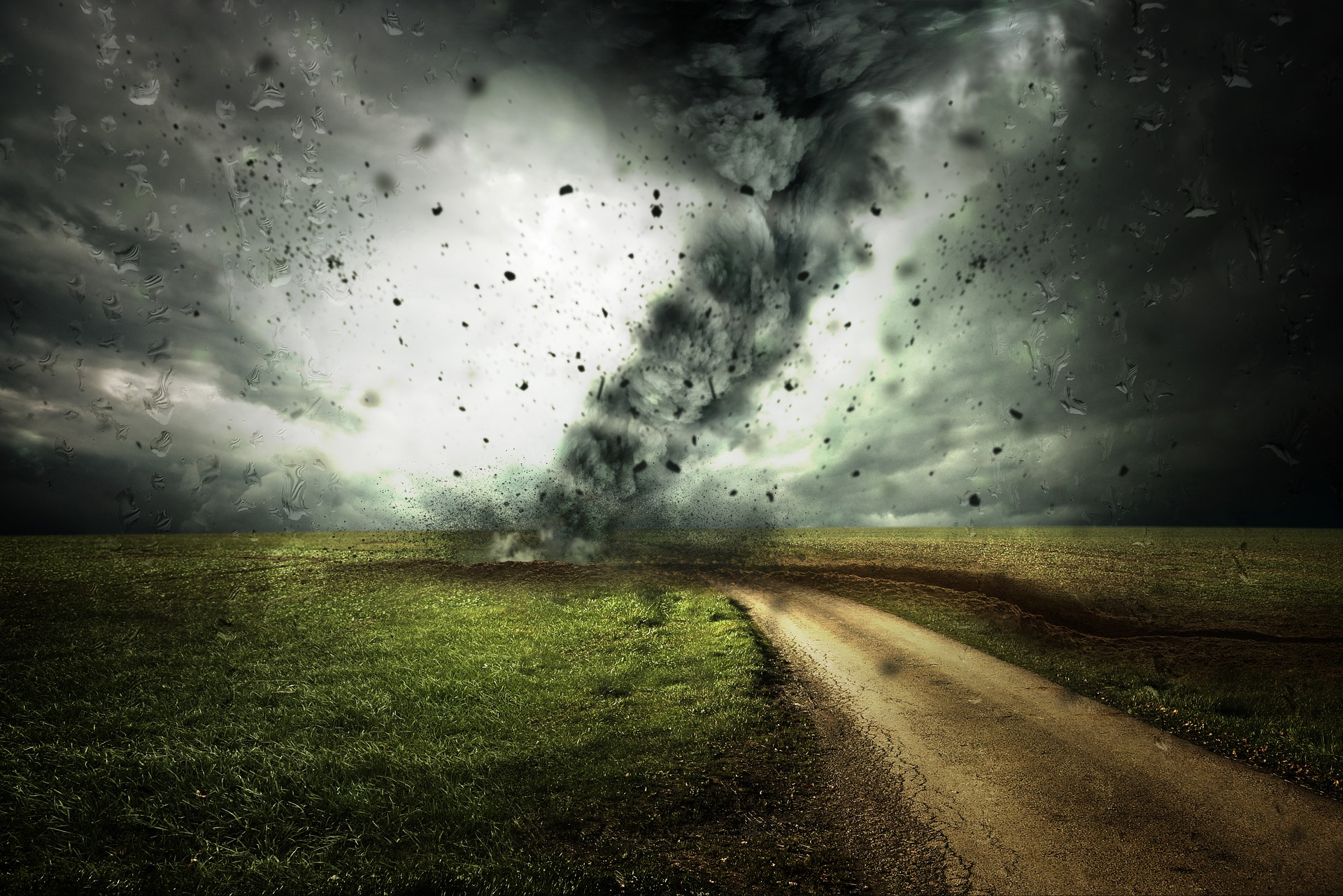
This must have been an incredible sight. A giant storm focused on this mountain, the Lord coming in fire, the earth trembling at His coming and His voice thunders as He gives Moses the ten commandments.
Now this fills us with awe. It would have been incredible, but I don’t think we can really appreciate from this far in the future the terrible sight this would have been. It would have been overwhelming. We actually see at the end of Exodus 20 that the Israelites are terrified by the entire spectacle.
Exodus 20:18–21
[18] Now when all the people saw the thunder and the flashes of lightning and the sound of the trumpet and the mountain smoking, the people were afraid and trembled, and they stood far off [19] and said to Moses, “You speak to us, and we will listen; but do not let God speak to us, lest we die.” [20] Moses said to the people, “Do not fear, for God has come to test you, that the fear of him may be before you, that you may not sin.” [21] The people stood far off, while Moses drew near to the thick darkness where God was. (ESV)
The Israelites didn’t want to go anywhere near their God. They said “You go Moses, we will talk to you, but don’t let God speak to us.” Wow. How often do we do this same thing?
Just this week someone was telling me about a friend of theirs who would come to them and ask them questions about the scriptures and they would say “Now Smith, what do you think about - whatever. I don’t have time to look into this myself, so you look it up and tell me what you find.”
We think, let’s listen to music singing about God. Let’s listen to a sermon, (but only if it is uplifting) but we don’t want to read the Word of God and let God speak directly to us. That would be too terrifying.
We are of Zion
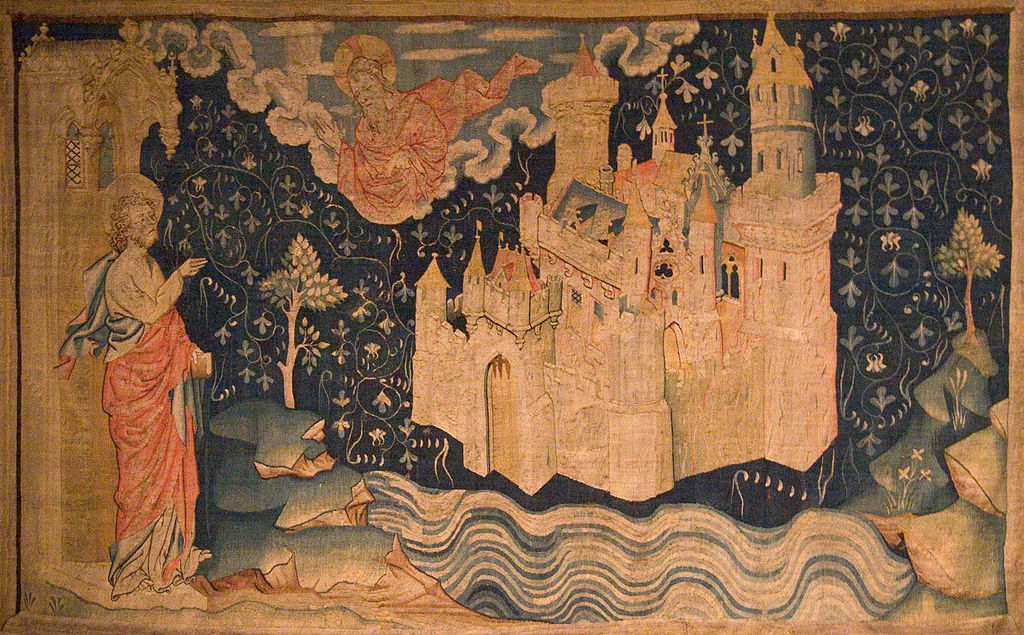
By Kimon Berlin, user:Gribeco [GFDL, CC-BY-SA-3.0 or CC BY-SA 2.5-2.0-1.0], via Wikimedia Commons

But this isn’t the sight we come to as Christians today. This is the covenant that preceded us. We no longer approach the mountain of Sinai. This is gone and we can’t get it back. Nor would we want to when we realise what we have come to. We are of the city of Zion. The process of becoming holy, while difficult doesn’t come from the mountain of law. Instead the process of making us holy brings us to Mount Zion, and the contrast here is palpable in these verses.
Hebrews 12:22–24
[22] But you have come to Mount Zion and to the city of the living God, the heavenly Jerusalem, and to innumerable angels in festal gathering, [23] and to the assembly of the firstborn who are enrolled in heaven, and to God, the judge of all, and to the spirits of the righteous made perfect, [24] and to Jesus, the mediator of a new covenant, and to the sprinkled blood that speaks a better word than the blood of Abel. (ESV)
No more fire and brimstone no more thunder and lightning. Instead we see the heavenly Jerusalem where there are innumerable angels in festal gathering. We see the assembly of the firstborn, we see the spirits of the righteous made perfect, God, the judge of all, and Jesus the mediator of a new covenant who sprinkles us with His blood.
A place that sounds of peace, where God dwells and we can approach without fear because of the process of becoming holy. Now I want us to look at the language here, it says “But you have come to Mount Zion”. It does not say “You will come” someday in the future when you have completed your work here. It says to these Christians, you have come. We are a part of this holy city if we are Christians today. And while we may be standing at the foot of the mountain and not currently living in heaven, We are citizens of heaven. Not of Australia, or America, or India, or New Zealand, or South Africa, or anywhere else. We are, right now, citizens of heaven.
Our God is a consuming fire
Lastly, we must remember who the God of this city is. While we do enjoy a new covenant that is sooo much better than the law, we should remain concious that the God of the Old Testament is the same God of the New Testament.
Hebrews 12:25–29
[25] See that you do not refuse him who is speaking. For if they did not escape when they refused him who warned them on earth, much less will we escape if we reject him who warns from heaven. [26] At that time his voice shook the earth, but now he has promised, “Yet once more I will shake not only the earth but also the heavens.” [27] This phrase, “Yet once more,” indicates the removal of things that are shaken—that is, things that have been made—in order that the things that cannot be shaken may remain. [28] Therefore let us be grateful for receiving a kingdom that cannot be shaken, and thus let us offer to God acceptable worship, with reverence and awe, [29] for our God is a consuming fire. (ESV)
We can understand this metaphore similarly to how mixtures are separated in a lab. If you have watched CSI shows you may have seen this, it is called a centrifuge.
A centrifuge is a piece of equipment that puts an object in rotation around a fixed axis (spins it in a circle), applying a potentially strong force perpendicular to the axis of spin (outward). The centrifuge works using the sedimentation principle, where the centripetal acceleration causes denser substances and particles to move outward in the radial direction. At the same time, objects that are less dense are displaced and move to the center. In a laboratory centrifuge that uses sample tubes, the radial acceleration causes denser particles to settle to the bottom of the tube, while low-density substances rise to the top.
Sited from Wikipedia, Feb 2nd 2018.
What can be separated is separated from this great force, it is shaken so that the particles that are wanted can be separated and taken out. In our Biblical account, what is is shaken, so that what cannot be shaken will remain.
Mount Zion is a place of goodness and perfection. It is also a kingdom of permenance that we see here. What is (The Old Covenant) will be shaken so that what cannot be shaken (The New Covenant) will remain. However, it is still the same God who calls us. The God who calls us should not be refused. If we do, as the Israelites often did, then we will not escape judgement. There are many verses we can look to in order to see this. If we look to Deuteronomy 4:3 Moses is reminding the people as they are about to enter the promised land not to forget what God does with those who bind themselves to other Gods. The event Moses reminds them of is from Numbers.
Numbers 25:3–5
[3] So Israel yoked himself to Baal of Peor. And the anger of the LORD was kindled against Israel. [4] And the LORD said to Moses, “Take all the chiefs of the people and hang them in the sun before the LORD, that the fierce anger of the LORD may turn away from Israel.” [5] And Moses said to the judges of Israel, “Each of you kill those of his men who have yoked themselves to Baal of Peor.” (ESV)
In this event over 24,000 people died. Israel was God’s. When they abandon Him, when they yolk themselves to other Gods, He is within His right as ruler to bring judgement. They didn’t escape, although they were a part of His nation and we will not escape even though we are citizens of heaven.
We are citizens of Earthly nations, and when we break the laws we expect to be punished. If we speed, we get a ticket, if we steal we must pay it back and then some, on and on.
The God, the judge of all, is in Zion. So on the earth we dwell as members of the holy city, because if you look at these verses we are members now. If we now choose not to obey, well then we will not escape His judgement.
The old covenant is gone. The new covenant is here and it is so much better than what is gone. However, we serve the same God and King today. So let us do as these last verses say, “let us offer to God acceptable worship, with reverence and awe, (REMEMBER) for our God is a consuming fire.”